Abstract
Chronic obstructive pulmonary disease (COPD) remains a leading driver of emergency hospital admissions across the United Kingdom and Ireland. Approximately 190,000 COPD-related emergency admissions occur annually across these five nations, placing sustained strain on hospital bed capacity and emergency medical services. Pulmonary rehabilitation (PR) is a well-established intervention that improves functional outcomes and reduces exacerbation frequency. Emerging evidence suggests that widespread uptake and completion of PR could significantly reduce emergency admissions, improve hospital flow, and alleviate system-wide pressures, including ambulance delays and critical incidents. This article explores the potential system-level impact of PR when delivered at scale.
Introduction
Health systems across the UK and Ireland are experiencing persistent pressure from rising demand, limited bed capacity, and increasing patient complexity. Bed occupancy regularly operates at or near maximum levels, leaving little resilience to absorb acute surges in demand (British Medical Association, 2025). [irishexaminer.com]
At the same time, COPD continues to generate a high volume of emergency admissions, many of which are associated with acute exacerbations. These episodes are frequently preventable and represent a critical opportunity for intervention (Department of Health and Social Care, 2026). [pmc.ncbi.nlm.nih.gov]
Pulmonary rehabilitation, a structured programme of exercise, education, and self-management support, is recommended in international guidelines, yet completion rates remain suboptimal.
Burden of COPD on Emergency Care
Across the UK and Ireland, COPD accounts for an estimated 185,000–200,000 emergency hospital admissions annually, with England alone contributing approximately 120,000 cases per year (Office for Health Improvement & Disparities, 2026). [pubmed.ncb…lm.nih.gov]
These admissions place direct pressure on emergency departments, inpatient bed capacity, and ambulance services. They are also associated with high rates of recurrence, with exacerbations driving repeat healthcare use.
System Constraints: Bed Capacity and Flow
Hospital bed capacity remains a key limiting factor across health systems. The UK has approximately 2.4 hospital beds per 1,000 population, significantly lower than the European average (British Medical Association, 2025). [irishexaminer.com]
This structural constraint contributes to persistent high occupancy, delayed admissions from emergency departments, and increased use of escalation spaces.
In Ireland, hospital overcrowding is evidenced by hundreds of patients waiting on trolleys daily, often requiring surge capacity measures (Health Service Executive, 2026). [thorax.bmj.com]
When bed availability is constrained, system flow deteriorates, negatively affecting patient safety and experience.
Downstream Effects: Ambulance Delays and Critical Incidents
Hospital overcrowding has direct consequences for pre-hospital care. When beds are unavailable, ambulance handover delays occur, limiting the ability of emergency services to respond to new calls.
During periods of sustained pressure, hospitals may declare critical incidents, indicating that services cannot be delivered safely under existing conditions (NHS England, 2026). [rte.ie]
These events are closely associated with surges in admissions and bed shortages, particularly during seasonal peaks in respiratory illness.
Pulmonary Rehabilitation: Evidence of Impact
Pulmonary rehabilitation has demonstrated consistent benefits in reducing healthcare utilisation:
- A 30–40% reduction in hospital admissions (Meneses-Echavez et al., 2023; Moving Medicine, 2022) [nrap.org.uk], [fingertips…phe.org.uk]
- Up to a 50% reduction in readmissions (American College of Chest Physicians, 2024) [express.co.uk]
- Significant reductions in exacerbation frequency (van Ranst et al., 2014) [gov.uk]
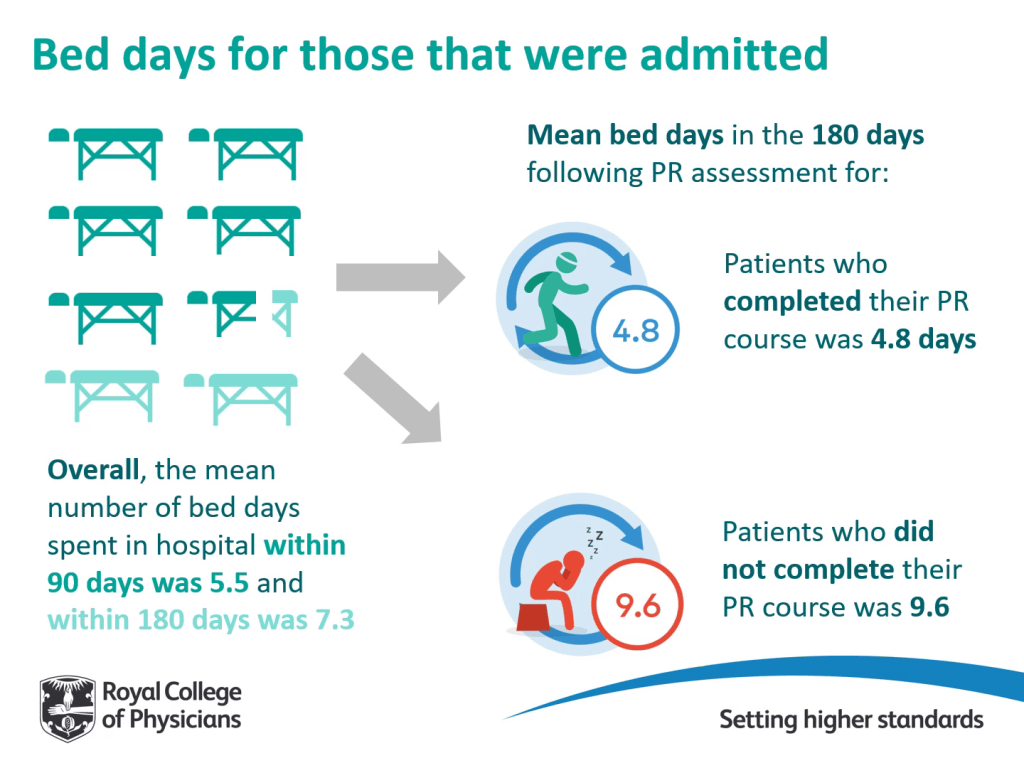
- Reduced length of hospital stay among completers (Royal College of Physicians, 2017) [nrap.org.uk]
These findings position PR as a high-value intervention capable of reducing demand across acute care services.
Projected System-Level Impact Across Five Nations
Reduction in Admissions
Applying a conservative 30–40% reduction:
- 55,000–75,000 admissions avoided annually
Release of Bed Capacity
With an average length of stay of 5–7 days:
- 275,000–525,000 bed days freed annually
- Equivalent to 750–1,400 beds available daily
Impact on Emergency Services
- Reduced ambulance conveyances
- Improved handover times
- Enhanced response capacity
Impact on System Resilience
- Fewer critical incidents
- Reduced reliance on surge capacity
- Improved elective care continuity
Discussion
Pulmonary rehabilitation is traditionally viewed as a clinical intervention focused on improving individual patient outcomes. However, its wider impact extends to system-level performance.
By reducing one of the most common causes of emergency admission, PR can:
- Decrease emergency department demand
- Improve inpatient flow
- Relieve pressure on ambulance services
Despite this, access to PR remains inconsistent, and completion rates are low. Addressing barriers to access, referral, and engagement is critical to realising its full potential.
Conclusion
COPD exacerbations represent a major and largely modifiable driver of health system pressure. In the context of limited bed capacity and growing emergency demand, pulmonary rehabilitation offers a scalable and evidence-based solution.
If implemented effectively across the UK and Ireland, PR could significantly reduce emergency admissions, increase bed availability, improve ambulance response times, and enhance overall system resilience.
Key Message
Pulmonary rehabilitation is not only a clinical intervention—it is a critical system strategy for reducing admissions, freeing hospital capacity, and stabilising emergency care services.
References
American College of Chest Physicians (2024) Trends in pulmonary rehabilitation enrollment following admission for acute exacerbation of COPD. Chest Journal. Available at: https://journal.chestnet.org
British Medical Association (2025) NHS hospital beds data analysis. Available at: https://www.bma.org.uk [irishexaminer.com]
Department of Health and Social Care (2026) Respiratory disease profile: statistical commentary. Available at: https://www.gov.uk [pmc.ncbi.nlm.nih.gov]
Health Service Executive (2026) Urgent and emergency care report. Available at: https://www2.hse.ie [thorax.bmj.com]
Meneses-Echavez, J.F. et al. (2023) ‘Pulmonary rehabilitation for acute exacerbations of COPD: A systematic review’, Respiratory Medicine, 219. [nrap.org.uk]
Moving Medicine (2022) COPD – Decreased time in hospital / bad days (evidence summary). Available at: https://movingmedicine.ac.uk [fingertips…phe.org.uk]
NHS England (2026) Critical incident definitions and escalation pressures. Available via NHS and media sources [rte.ie]
Office for Health Improvement & Disparities (2026) COPD emergency hospital admissions data. Available at: https://fingertips.phe.org.uk [pubmed.ncb…lm.nih.gov]
Royal College of Physicians (2017) Pulmonary rehabilitation: Beyond breathing better. Available at: https://www.rcp.ac.uk [nrap.org.uk]
van Ranst, D. et al. (2014) ‘Reduction of exacerbation frequency in patients with COPD after pulmonary rehabilitation’, International Journal of COPD, 9, pp. 1059–1067. [gov.uk]